Free Standing Fryers Range
To suit the demands of different commercial kitchens, Valentine free standing fryers are available in two distinct series, designed to offer flexibility in performance, control and functionality. Whether you’re looking for dependable everyday operation or a more advanced feature set, there’s a solution tailored to your service style.
The CORE range provides a streamlined, reliable frying solution focused on consistency, durability and ease of use. It delivers the essential performance professional kitchens rely on, with straightforward operation and robust construction designed for daily commercial use.
For kitchens seeking greater control and enhanced functionality, the CORE Smart range builds on this foundation with added technology and intelligent features. Designed to support more precise cooking management and improved workflow efficiency, it offers an elevated frying experience without compromising simplicity or reliability.
Together, the CORE and CORE Smart ranges ensure every kitchen can find a Valentine free standing fryer that aligns with its needs, delivering consistent results, operational efficiency and long term performance in demanding environments.
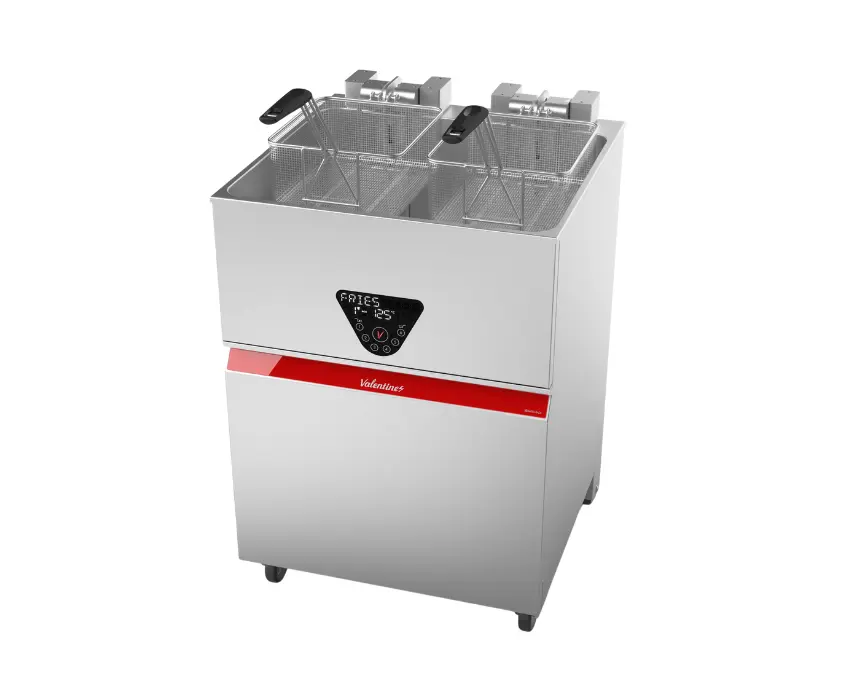
Free Standing CORE Smart Fryer Range
The Valentine CORE Smart range takes frying performance to the next level with enhanced technology and intelligent features. Designed for greater control, precision and efficiency, it helps streamline cooking processes while maintaining consistent, high quality results. Ideal for kitchens looking to optimise workflow and improve operational control, CORE Smart combines reliability with advanced functionality.
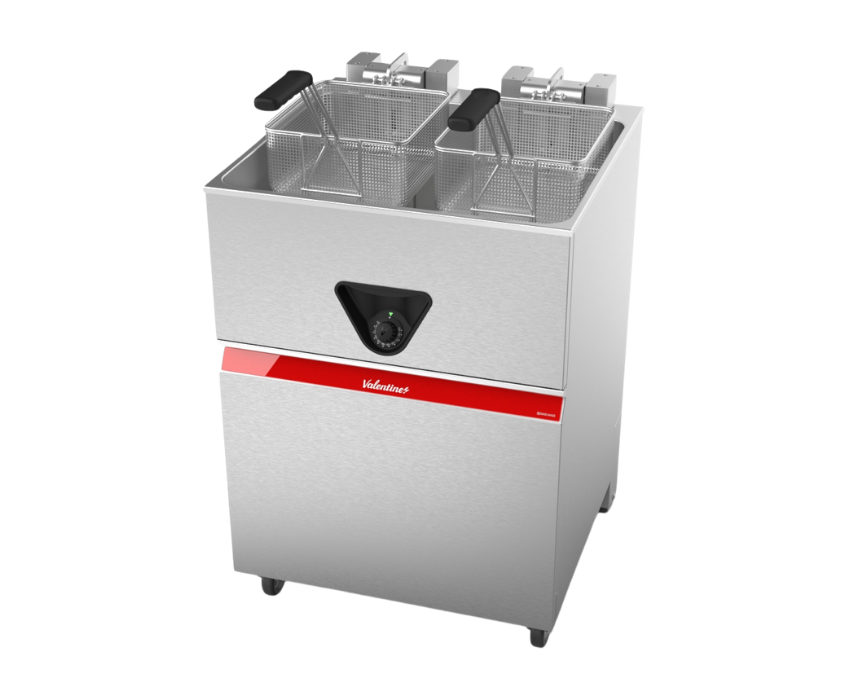
Free Standing CORE Fryer Range
The Valentine CORE range delivers dependable performance and everyday reliability for busy commercial kitchens. Designed for straightforward operation and consistent results, it focuses on the essential functions chefs need most. Built with durability, ease of use and simple maintenance in mind, CORE fryers provide a solid, no fuss solution for high demand frying environments.
Valentine Electric Deep Fryer CORE Range FAQ's
Features | Valentine Fryers | Typical Commercial Fryers |
Design Origin | Swiss engineered with focus on precision and durability | Varies widely, often mass produced |
Cooking Performance | Stable temperature control with consistent frying results | Can fluctuate under heavy load |
Oil Management | Deep Cool Zone design helps extend oil life and reduce burning | Limited cool zone efficiency in many models |
Build Quality | Heavy duty stainless steel construction built for long service life | Mixed build quality depending on brand tier |
Cleaning & Maintenance | Smooth, rounded interiors designed for easy cleaning | Often more complex internal structures |
Heat Recovery | Fast heat recovery for continuous high volume service | Slower recovery during peak demand |
Efficiency | Designed to optimise energy use and reduce oil wastage | Varies, often less optimised |
Suitability | Built for demanding, high output commercial kitchens | Ranges from light duty to heavy duty model |
Feature | CORE Range | CORE Smart Range |
Control System | Standard electronic controls for reliable manual operation | Intelligent Smart Control system with adaptive cooking technology |
Cooking Programs | Basic programmable functions depending on model | 6 pre set cooking programs + fully customisable program per tank |
Operation | Independent tank operation with standard user control | Independent tank control with enhanced smart monitoring and automation |
Cooking performance | Consistent temperature control for dependable frying results | Adaptive cooking technology that adjusts to load for optimised consistency |
Automation Features | Minimal automation, manual basket handling | Optimal automated basket lift with programmed cooking cycles |
Oil Management | Standard heating and temperature stability | Enhanced oil protection with intelligent monitoring and Cool Zone efficiency |
Cleaning System | Manual cleaning process | Dedicated cleaning mode to support easier maintenance |
Energy Efficiency | Standard energy efficient operation | ECO Mode for reduced energy consumption and improved efficiency |
Serviceability | Traditional servicing access | Cartridge style removable control box for fast, non disruptive servicing |
Valentine offers multiple fryer series to meet the different operational needs, skill levels and levels of control required across commercial kitchens. The fryers are designed to be flexible and scalable, with each model built on the same high performance foundation but tailored to different ways of working:
- CORE range focuses on simplicity, reliability and ease of use, ideal for kitchens that want consistent output with minimal training or complexity.
- CORE Smart range introduces advanced electronic controls that analyse and adapt cooking automatically, delivering higher precision, consistency and automation for more demanding or multi site operations.
By offering both, Valentine ensures operators can choose the level of control, automation and investment that best suits their kitchen without compromising on core performance, efficiency or build quality.
To conclude, different series exist to give kitchens the right balance between simplicity and smart technology, depending on their needs.
Yes - while both ranges are built on the same high performance platform, the CORE Smart series is better suited to more advanced or high demand kitchens.
The CORE range delivers strong output, fast recovery and energy efficiency with simple, manual operation, making it ideal for busy kitchens that prioritise reliability and ease of use.
The CORE Smart range, however, is designed for operations that need greater control, consistency and automation at scale. Its intelligent system continuously analyses and adapts the cooking process, offers programmable settings and maintains precise temperature control helping maintain quality during peak service or across multiple operators.
In short:
- CORE: Best for high output kitchens wanting simplicity and durability.
- CORE Smart: Best for high demand or multi site kitchens needing precision, automation and consistent results under pressure.
When deciding between CORE and CORE Smart, the key factors come down to operational complexity, control requirements, kitchen volume and levels automation needed.
- Level of control needed: CORE is ideal if you prefer simple, manual operation with consistent results, while CORE Smart is better if you want precise, programmable and adaptive cooking control.
- Kitchen Volume and Demand: CORE suits reliable high-output day-to-day frying, where as CORE Smart is designed for high demand or multi operator kitchens where consistency across busy service is critical.
- Skill Level and Consistency needs: If staff training varies or you need repeatable results across different users, CORE Smart helps reduce variation through automatic adjustments and programmed settings.
- Operational priorities: CORE prioritises ease of use and durability, while CORE Smart adds energy optimisation, safety features and adaptive cooking technology for more efficient long term operation.
Choose CORE for straightforward, robust frying.
Choose CORE Smart if you need greater precision, atomisation and consistency in more demanding kitchen environments.
Yes. CORE Smart is better suited for more complex kitchen operations where consistency, control and efficiency need to be tightly managed across different users and service conditions.
It is designed for environments such as multi-site groups, high volume kitchens or operations varying staff skill levels, where maintaining consistent frying results is critical.
CORE Smart achieves this through features like:
- Adaptive cooking technology that adjusts to load size for consistent results
- High-precision temperature control (±1°C) to reduce variations between operations
- Programmable cooking settings to standardise recipes and reduce training dependency
- Enhanced monitoring and safety systems that support continuous, high demand use
- Automation features such as basket lift and filtration to reduce manual steps and improve workflow efficiency
The choice ultimately depends on whether the kitchen prioritises operational simplicity or greater automation and process control.
Yes. More advanced fryer systems are specifically designed to maintain consistent performance under heavy, continuous demand, which is critical during peak service periods.
During busy service, every time a large batch of food is loaded into the fryer, the oil temperature drops. The key factor is how quickly and consistently the fryer can recover back to its set temperature. Faster recovery and tighter temperature control help prevent delays, uneven cooking and reduced output.
Advanced fryer systems support peak performance by:
- Recovering heat faster between batches, allowing continuous back to back frying
- Maintaining more stable oil temperatures, reducing quality variations between operators
- Improving throughput, so more orders can be processed per hour without bottlenecks
- Reducing oil degradation caused by prolonged low temperature frying, helping maintain food quality during long rushes
More advanced systems, such as those with intelligent controls or adaptive cooking features, also help reduce operator error during high pressure service by standardising cooking conditions.
In contrast, simpler systems can still perform well but may require more operator attention to manage temperature recovery and consistency during heavy demand.
Fryer technology directly affects how much training staff need and how consistently they can perform during service. Basic fryer systems rely more on operator skill, meaning staff must be trained to manage temperature, timing and consistency manually.
More advanced systems reduce this dependency by standardising key processes through features like:
- Programmable cooking presets
- Precise temperature control
- Automated or guided cooking cycles
- Faster heat recovery for stable performance during service
This helps reduce training time, supports less experienced staff and improves consistency across different operators and shifts.
Fryer technology helps reduce waste and improve efficiency by giving kitchens greater control over cooking conditions and oil management.
More advanced systems improve efficiency by:
- Maintaining stable temperatures, reducing overcooking or product loss
- Recovering heat faster, allowing continuous production without downtime
- Optimising energy use, so the fryer works more efficiently during peak service
- Extending oil life through better temperature control and cool zone design, reducing how often the oil needs to be replaced
- Standardising cooking results, which reduces product inconsistency and discarded batches
By improving consistency and control, technology helps kitchens run more predictably, with less waste and more efficient use of both energy and ingredients.
When comparing commercial fryer brands, it helps to look beyond price and focus on how the equipment will perform in a real kitchen environment. Key differences usually come down to efficiency, consistency, durability and ease of operation.
Here are the most important factors to consider:
- Temperature stability and recovery time - how well the fryer maintains heat during back-to-back service and how quickly it recovers after food is loaded. Faster recovery means more consistent output during peak periods.
- Oil management and longevity - features like a cool zone or filtration system help reduce burning debris and extend oil life, lowering ongoing operating costs.
- Energy efficiency - how effectively the fryer uses gas or electricity to maintain performance, especially during continuous operations.
- Ease of cleaning and maintenance - design features such as smooth tanks, drain access and removable components affect daily workflow and downtime.
- Control system and usability - manual vs digital controls, programmability and consistency across different operators.
- Capacity and configuration - oil volume, basket size and whether multiple units are needed for different products or allergens.
- Suitability for your kitchen volume - whether the fryer is designed for light duty, medium or high output commercial use.
Overall, the best fryer brand for you is the one that matches your service volume, menu type and operational style, not just the upfront specification sheet.
A good starting point is to think about how the fryer will be used in your kitchen and the level of control you need.
Begin by considering:
- Whether you need a manual, semi automated or fully automated system, depending on how simple or advanced you want day to day operation to be
- If energy efficiency is a priority for your business and long term running costs
- The volume of food you need to produce, which will help determine the right capacity and output level
- Whether you will be using one type of oil or multiple oils, which can influence tank configuration and basket setup
These factors will help narrow down the most suitable range and size for your operation.
If you are still unsure, it's best to speak with our Sales team by filling in the form on our Contact us page or call us on 1300 405 404 and they can guide you through the options available and recommend the most appropriate fryer setup based on your specific kitchen needs.